Drop us an email!
By clicking the button you agree to our Privacy Policy.
Masterplan
Masterplan (kind of)
Building Aurora means linking a lot of moving parts. Choose a crop mix for year‑round food and the irrigation schedule, labour plan, and storage layout all shift; tilt a roof for cooler rooms and the solar array, battery bank, and ventilation strategy move with it. Housing, food, energy, water, waste, money, and daily life form one long chain. Miss a link and issues arise.
Because of that, the project turned into a set of parallel studies. For every topic we asked, “If we do it this way, what happens to everything else? And what happens in thirty years?” Then we checked the knock‑on effects, made adjustments, and ran the loop again. It’s slower (and sometimes more expensive) than grabbing off‑the‑shelf answers, but it’s the only way the place works as a single system and gives us a real shot at meeting our goals and delivering something useful.
Because of that, the project turned into a set of parallel studies. For every topic we asked, “If we do it this way, what happens to everything else? And what happens in thirty years?” Then we checked the knock‑on effects, made adjustments, and ran the loop again. It’s slower (and sometimes more expensive) than grabbing off‑the‑shelf answers, but it’s the only way the place works as a single system and gives us a real shot at meeting our goals and delivering something useful.
We tackle each problem with two rules: stay humble and keep pushing. Humble, because nature, budgets, and physics don’t care about our first intuitions or desires. Tenacious, because many workable solutions sit on the far side of plenty of study, testing, and fuckups. The first step is always saying "I don't know".
Galileo said it best, in 1612: "Name and attributes must accommodate themselves to the essence of things, and not the essence to names; for before were things, and then names".
Also, as an NGO, any monetary surplus (a.k.a. revenue) feeds scholarships, local projects, and micro-startups. Conservation, agriculture, and charity aren’t add‑ons; they’re threads woven through the same web of decisions.
The goal is simple: living lightly on the land, giving back to the people around us, and protecting the landscape that makes it all possible.
Galileo said it best, in 1612: "Name and attributes must accommodate themselves to the essence of things, and not the essence to names; for before were things, and then names".
Also, as an NGO, any monetary surplus (a.k.a. revenue) feeds scholarships, local projects, and micro-startups. Conservation, agriculture, and charity aren’t add‑ons; they’re threads woven through the same web of decisions.
The goal is simple: living lightly on the land, giving back to the people around us, and protecting the landscape that makes it all possible.
Main focus areas
- Regenerative AgricultureWe take care of the land and its ecosystems. Our focus is on improving soil fertility, increasing biodiversity, and keeping productivity steady without damaging the nature around us. We compost, we use cover crops, we grow perennial vegetables, and we rotate a few annual plots when needed. The hope is that Aurora can provide nutritious and diverse food for the people who live here without compromising the web of biodiversity.
At the same time, this does not mean we reject "chemical fertilizers" or deny their role in lifting hundreds of millions of people out of hunger. We simply hope society will develop more nature-friendly alternatives. Meanwhile, we don’t use "chemical fertilizers" on our farm and we encourage our neighbors to avoid them only when a viable, productive alternative exists. The same applies to "chemical pesticides".
TL;DR: produce steady, diverse food without external dependence, while enriching rather than depleting the soil. - ArchitectureOur buildings are designed to capture cooling breezes and harness natural light, reducing reliance on air conditioning (which we did not install) and artificial lighting. Rainwater harvesting, solar arrays, and insulated roofs help conserve resources and provide a fresh environment.
We used ancient materials and technologies, such as clay blocks and lime plaster, together with new strategies, such as solar water heating and a raised steel structure. We also added some unusual but very important features, such as push button showers (to save water), composting toilets, and a dedicated greywater recycling system for each house.
The floor plans focus on cozy, space-efficient rooms while encouraging communal living through open and naturally lit shared spaces. In short, we are building modern-looking, long lasting and non-toxic homes designed to work well with the environment and with the people who live in them.
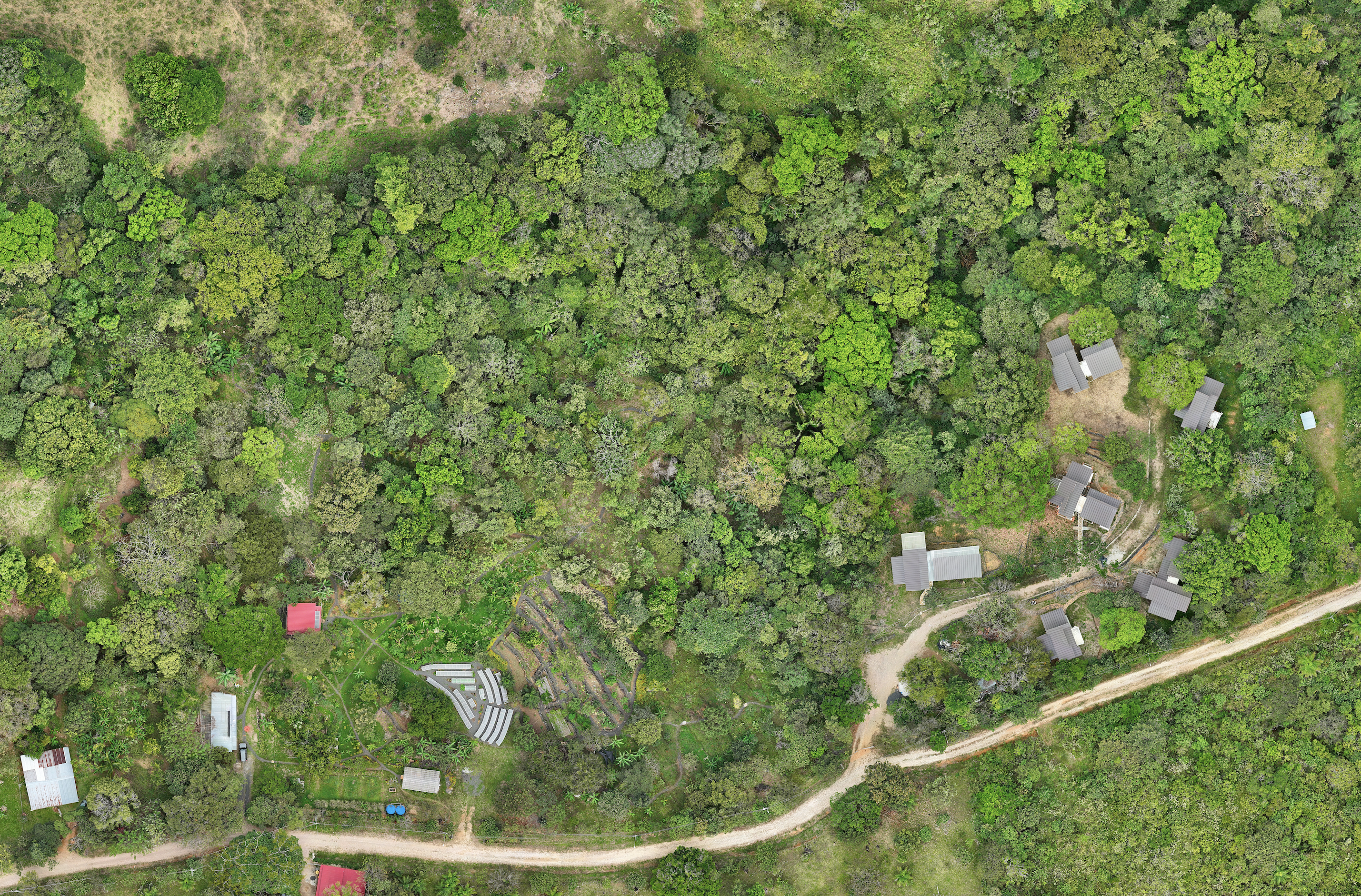
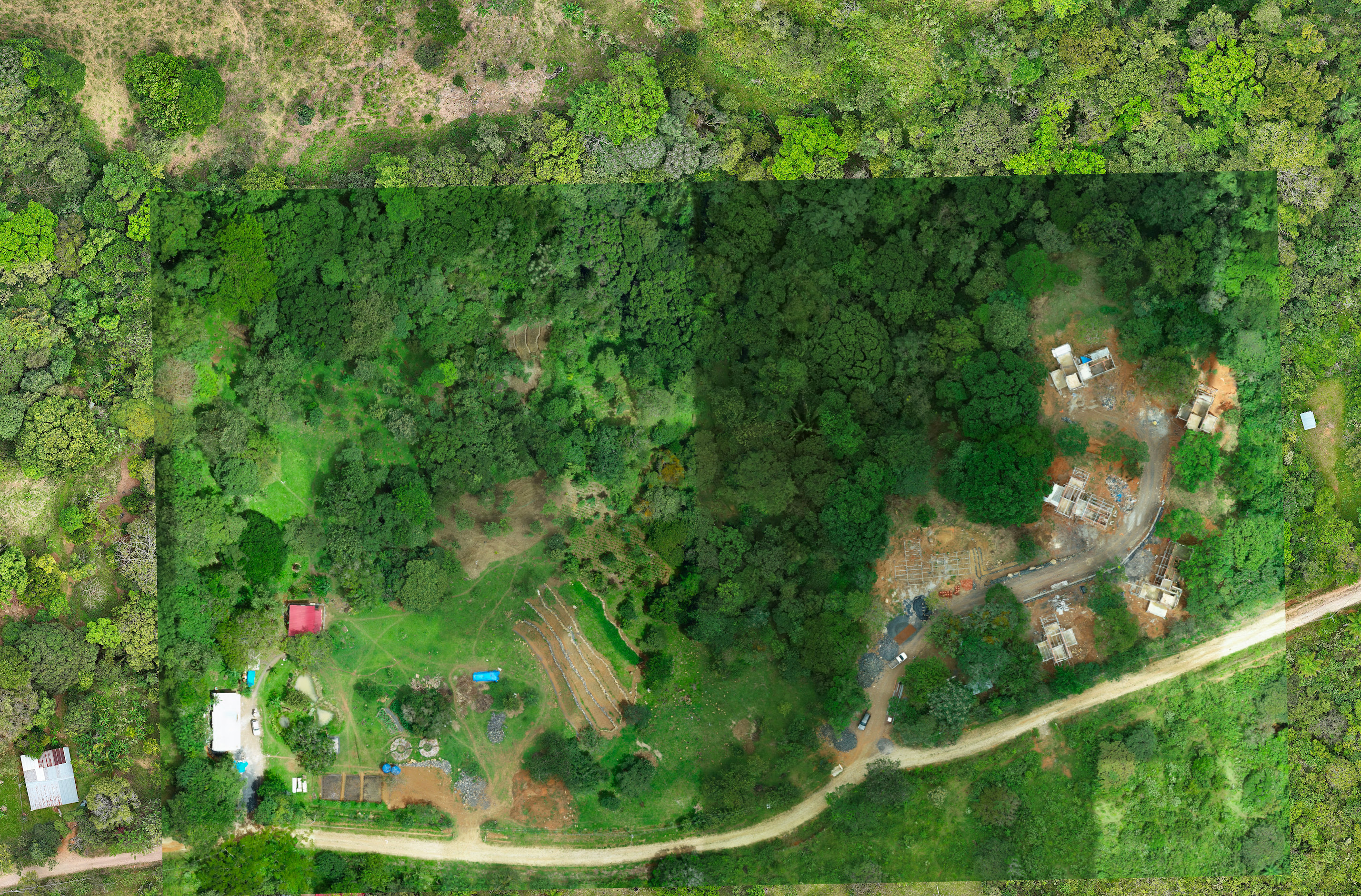
TL;DR: modern, durable, passive-solar, comfortable, sustainable, non-toxic houses. - UrbanismWe designed the residential area around the nature we found when we first arrived. The number, size, shape, and position of the houses depend entirely on the topography and existing ecosystem. We didn’t reshape the land to fit our preferences. Instead, we reshaped our preferences to respect the land.
All houses are connected by footpaths to encourage communal living and movement on foot. We built only one parking space so that cars stay put and people walk, while still providing easy access for emergency services. A few trails through wild vegetation connect the residential side with the farm side of the property.
This is an experiment on how 20+ people can live together in a nature-friendly way, with modern amenities and without destroying the ecosystem.
TL;DR: live closely together in modern structures fully integrated into the ecosystem: outside feels like a forest, inside feels like a normal home. - Ecosystem ConservationWe try to ensure that the tropical habitats and biodiversity around us continue to thrive. We keep natural corridors open for wildlife and pollinators, so cultivated areas, native flora, and living spaces can coexist without competing. Our agroforestry plots, with mixed tree species interplanted with crops, help protect soils from erosion and add structural diversity to the landscape.
The houses are also designed to be non-polluting throughout their lifespan, thanks to composting toilets and branched-drain greywater systems.
TL;DR: leave the ecosystem healthier and richer than it was when we arrived. - PhilanthropyFor us, philanthropy is simply a way of using the farm’s resources to support the community and the environment around us. Farm profits go back into local project, such as healthcare initiatives, scholarship funds, and small-scale financing for farmers and entrepreneurs. When helpful, we share seeds, training, and know-how to support neighbors who want to adopt more sustainable practices.
Events and workshops supported by donations help raise awareness about regenerative agriculture, ecosystem restoration, and responsible consumption.
TL;DR: within 20 years we aim to return to the community the full monetary value it took to build everything, through local and educational projects; a “moral mortgage”. - EducationEducation is part of how life at the farm naturally works. Visitors, residents, volunteers, and researchers learn by observing and participating in what we do every day. We offer hands-on experience in organic farming, agroforestry, composting, off-grid energy and water systems, mixing theory with practice.
We don’t see ourselves as teachers. We simply do our work and hope others can learn together with us, especially from our mistakes.
On some level, the education is provided by both us and the people who visit, because we can never anticipate the skills and knowledge that people will bring to the table. We just make the connection possible while sharing what we know about how things work at the farm.
TL;DR: make our efforts useful to the people around us and those who visit, being a positive example where possible. - Self-SufficiencySelf-Sufficiency serves as a guiding principle, enabling the farm to produce resources independently while minimizing external dependencies. The integrated agricultural system yields a variety of fruits, vegetables, and herbs, ensuring a consistent food supply throughout the year.
Renewable energy, sourced from solar panels, powers daily operations, while rainwater catchment systems and efficient irrigation preserve water. Excess produce is transformed into value-added goods, fostering economic resilience. By embracing local inputs, resourcefulness, and eco-friendly innovations, the farm sustains its community, safeguards natural and financial capital, and models regenerative abundance.
It's also important to note that our goal of self-sufficiency doesn't originate from the idea that "modern society" is sick and we want to build a better one. Our connection with our social and economic environment is strong and we want to keep it that way. We wouldn't exist without all the incredible privilegies that modern society gives us. We just try to do our part in our own way, while at the same time cultivating resilience.
TL;DR: aim for maximum self-sufficiency while maintaining our connection to Santa Fe and its inhabitants. - Autonomous GovernanceAutonomous Governance at the farm is grounded in sociocracy rather than traditional democracy. Democracy tends to be slow, inefficient, and prone to factionalism. Sociocracy replaces majority rule with consent, asking not “Who wins?” but “Are there any reasoned objections?” This approach reduces conflict, avoids power blocs, and encourages personal growth by requiring everyone to study, express concerns clearly, listen deeply, and co-create decisions that are “good enough for now, safe enough to try.” Structured communication through circles, defined roles and transparent processes keeps decision-making efficient, fair and adaptive. Resource allocation, long-term planning and day-to-day operations all undergo review through these shared mechanisms.
Our long-term intention is for Aurora to become a fully self-managing and resilient NGO, capable of functioning even after the founders are gone. This distributes responsibility and creates stability and continuity for whoever joins in the future.
TL;DR: when the founders are old or gone, Aurora should continue on its own.
↑
←
→
↓
+
−
× ![]()